Module 4
Birdsall, J. (2008). The Penderwicks on Gardam Street. New York: Alfred A. Knopf.
The Penderwick sisters are back. This time, they have to work together to thwart their father’s half-hearted attempts to date again. (I completely understand his reticence). But this book is more than just scheming. It is sisterly love and support and the odd sisterly violence as well. It also has an extremely satisfying end.
My View:
I don’t remember having this much fun as one of the three Luker sisters. Oh, we all had our areas of expertise: I was the writer, Mara the musician, and Willow was the artist. In a way we all developed in each other’s areas as well, but with less whole-heartedness. The Penderwick sisters are also brilliant individuals, but with enough heart and caring for one another to make them human. Mr. Penderwick is one of my favorite characters. He is smart, funny, and broken hearted. I loved how the girls grew so quietly accustomed to their next door neighbor.
“ Jeanne Birdsall's second book about the Penderwick family is even better than her first. . . . Birdsall plans at least three more installments to this series.” Steele, L. (2008) The Penderwicks on Gardam Street (Review). School Library Journal, 54(9), p75-76.
Ideas for the library: In German, Hilary McKay’s Exiles book is titled Vier Verrückte Schwestern, or Four Crazy Sisters. Well, the Penderwicks are the closest characters I have found to an American approximation of McKay’s wonderful people. Over the years I have introduced many to McKay’s works, and now she has quite a following in Pocatello. The Penderwicks are just as enchanting and I will promote these books to the same folks.
10 August 2010
The Greatest Treasure of All
Barrows, A. (2006). Ivy + Bean. San Francisco, California: Chronicle Books.
Looking out from their own yards, neither Ivy nor Bean wants to get to know the other. But when circumstances bring them together, they immediately become best of friends. Neighborhood, look out!
My View:
It was my second day in Michigan and I was still reeling from the huge changes in my life. I had arrived home from a wonderful and life-enriching study abroad in England, then left to live in Michigan almost before the jet lag had worn off. I was still missing my friends in that green and pleasant land, and not quite ready to make new ones in a new, humid, rapid-paced place. But my roommate persuaded me to go to Ann Arbor to a meeting, and afterwards, a middle aged woman and her husband came up to us and asked us to join them for dinner. My roommate was pleased, I was quiet, and off we went. I don’t remember much about the dinner, just an impression of friendly country folk and a sense of welcome amid the strangeness of everything. Then we drove home to Howell and I went to sleep, still a bit askew in my directions and thoughts.
The next day we ran into the couple again, and as I was more awake and alert, we began to talk. Over the course of the next six months, my internal compass was completely realigned. I woke up to the realization that these fine folks were some of the best and most sincere friends I could ever have. I knew almost innately where their farm was, no matter where I moved throughout southeast Michigan. Even now I can point with precision to that center spot. Friendship is the greatest treasure of all.
“With echoes of Beverly Cleary's "Ramona" series, this easy chapter book will appeal to children who are graduating from beginning readers. The occasional black-and-white illustrations highlight the text and provide visual clues. The characters are appealing, the friendship is well portrayed, and the pranks and adventures are very much on grade level.”
Stone, E. O. (2006). Ivy and Bean (review). School Library Journal 52(7), 68.
Ideas for the library: Last year we made a Valentine’s Day display with the banner “Red any good books lately” hanging above it. This coming year, if I remember, I’d like to stock my children’s display shelf with books highlighting Great Literary Friendships: Anne and Diana; Ivy and Bean; Betsy and Tacey; Frances and Thelma; Henry and Mudge; Mr. Putter and Tabby; Nancy, George, and Bess; and of course, Arabel and Mortimer.
08 July 2010
Thank Goodness for a Comadre!
For Module 3
Canales, V. (2005). The Tequila Worm. New York: Wendy Lamb Books.
Sofia wants to continue her education, and she has won a scholarship to a prestigious school in Austin, Texas. But is she emotionally ready? Her large and loving extensive family helps her in many ways. There are chapters about making beans, planning a quinceanero, and other family activities. How can Sofia even think of leaving all that support behind?
My view:
One of the best books I've read so far for this intensive class has been The Tequila Worm, by Viola Canales. Maybe because in my neighborhood there are several wonderful, strong women whom I consider my "Comadres", I resonated very much with this idea as presented by Canales. I am a single mother, and I know there are some things I just don't do very well. As much as I try, I just can't be all things to my boys. But thankfully there are some wonderful people who have been able to step in at key times and give my children careful mothering (and fathering) in areas where I just am not qualified. My gratitude for these people is tremendous. I liked how Canales explained the role of the comadre, and I recognize such in my own life. I will be sharing this book with these key friends and pointing out how much their influence affects my life and the lives of my boys. This book also gave us a delicious meal. When I was reading the part about Sofia and her father cooking beans together, I put some pintos in a pot and cooked them the same way. As I was finishing the book, my beans were also done, and the boys and I had a delicious meal of pinto beans, sour cream, fresh green onions, spicy salsa, and chopped avocado. It was mouthwateringly good, and we will have this again. What more could anyone ask---a book full of love, and a wonderful, easy to follow recipe at the same time.
"Canales' exuberant storytelling, which, like a good anecdote shared between friends, finds both humor and absurdity in sharply observed, painful situations--from weathering slurs and other blatant harassment to learning what it means to leave her community for a privileged, predominately white school. Readers of all backgrounds will easily connect with Sofia as she grows up, becomes a comadre, and helps rebuild the powerful, affectionate community that raised her."
Engberg, G.(2005). The Tequila Worm. Booklist,102(4), 47.
Ideas for the library: Well, how could we possibly read this in a book group without eating chips and salsa? Maybe I'm just hungry, but all my library ideas involve food right now. We can have a quinceanero party for all the 15 year old teens, complete with cake and dresses. That's all Kath Ann needs---another crack-brained idea from above that she has to implement. At least she knows I'll help her!
Time Travel
For Module 3
Stead, R. (2009). When you reach me. New York: Wendy Lamb Books.
Miranda is so sad when her erstwhile best friend gets punched in the stomach and stops hanging out with her. To make things worse, a strange man seems to be living underneath the mailbox and chants strange words to himself. Then pieces of a strange mystery start to appear and Miranda finds herself part of something temporally impossible. Or is it possible?
My view:
I wish time travel was really possible. A couple of years ago I stumbled on I Am the Messenger, by Markus Zusak. You remember him---he wrote The Book Thief and won many honors for it. Anyway, I Am the Messenger was entrancing and confusing and beautiful---and written for an older audience than Rebecca Stead's Newbery Award winning book When You Reach Me. But the premise is somewhat similar. I liked the twisting and turning, even braiding of the different aspects of the plot together---like the "streaker" who ran through the streets and prevented school from being out one day. It was reminiscent of The Time-Traveler's Wife, in a way. Mainly, I loved the tying together of the love and the sacrifice and the cryptic phrase the man (I don't want to spoil anything) muttered. I also liked the connections between A Wrinkle in Time and the narrator---it shows that books can have marvelous and lasting impact on life. I feel an essay about this subject starting to sprout inside of me.
Because this book won the Newbery Award, it has myriad reviews. One from School Library Journal says, "The climax is full of drama and suspense. This story about the intricacies of friendship will be a hit with students."
Crewdson, A. (2009) When you reach me (review). School Library Journal 55(12), 69.
For an older group of kids in a book group, I could see pairing this book with the movie Somewhere in Time, or in a writing group having the participants write about something they would like to go back in time to change. Hey, maybe that can be a topic for my next meeting of Write On!
The Best Superhero Ever
For Module 2
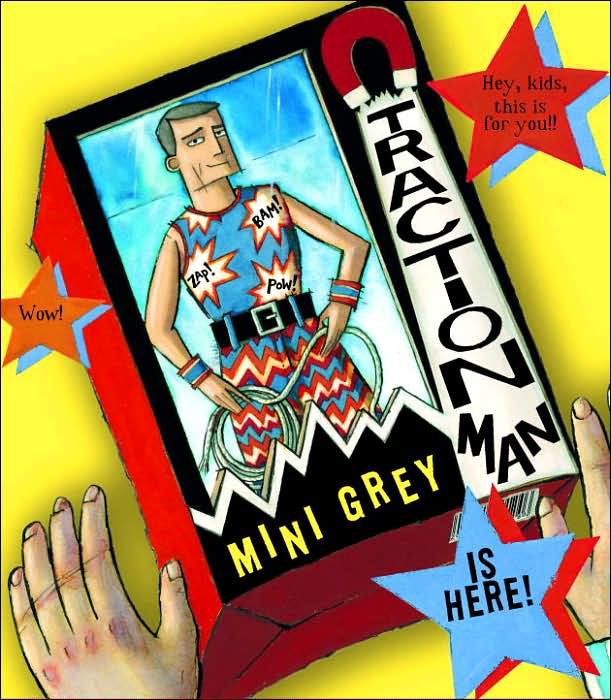
Grey, M. (2005). Traction man is here. New York: Alfred A. Knopf.
Traction man comes in a cool box with several changes of clothes and loud pants. From the very beginning he shows his true mettle by battling the evil pillows and saving the farm animals, then volunteering to explore the hidden submerged regions to search for the lost Wreck of the Sieve. Because it's Christmas, the superhero has to take a trip to Grandma's house where he, along with everyone else, receives a fancy knitted Christmas gift! But how can a superhero be brave and strong while wearing a green romper suit? Suddenly, Traction Man's loyal sidekick, Scrubbing Brush, comes up with a marvelous idea!
My view:
What a wonderful story! This is one of Will's favorites. We've read and reread this tale even though Will, at 9 years old, thinks he is too old for most picture books (he's not). But I don't think we ever outgrow Traction Man!
A review from School Library Journal had this to say about Traction Man Is Here: "Powered by a young boy's imagination, an intrepid action figure embarks on several perilous adventures accompanied by his faithful pet, Scrubbing Brush. Traction Man---along with everyday objects cast as villains and victims--springs to life through lively comic-book-style pictures and witty text.
In the library: Although this book is much more geared for lap reading (with so many different captions and interesting asides), it would be wonderful in a Superhero storytime lineup with such other books as Superhero ABC and Robot Zot! I can imagine making capes or loyal sidekicks as a craft.
- --- Traction Man Is Here (review). School Library Journal, 51, p38-38
19 June 2010
A Home Full of Light
For module 2: The House in the Night.
Swanson, S. M. (2008). The house in the night. Houghton Mifflin Company: Boston.
A child gets ready for bed and explores many different aspects of the house in the night and its contents.
My view:
Written by Susan Marie Swanson and illustrated by Beth Krommes, this beautiful book is, in my opinion, fully worth all the awards that can be bestowed upon it. Ever since I became acquainted with scratchboard in my botanical illustration class, I have been impressed with its excellent use. Beth Krommes has such beautiful artistry that I am impressed all over every time I see this lovely book. For me, however, the words are just as lovely as the pictures. I am a wordsmith and word lover first of all, so the simple story of a little one getting ready for bed is touching, especially because the language used is so evocative and simply resonant with beauty. Just try saying "starry dark" over and over again and maybe you'll be as enchanted as I. Not least is the chiasmic repetition of the elements in the story---moving forward and then tracing backward to make the reader exceedingly satisfied and moving into even a little bit of snuggly sleepiness at the end. Yes, this is a favorite book---one I intend to read to my grandchildren (when they come along in a couple of decades).
A review from Booklist, written by Irene Cooper, says in part, "Executed in scratchboard decorated in droplets of gold, Krommes’ illustrations expand on Swanson’s reassuring story (inspired by a nursery rhyme that begins, “This is the key of the kingdom”) to create a world as cozy inside the house as it is majestic outside. The two-page spread depicting rolling meadows beyond the home, dotted with trees, houses, barns, and road meeting the inky sky, is mesmerizing. The use of gold is especially effective, coloring the stars and a knowing moon, all surrounded with black-and-white halos. A beautiful piece of bookmaking that will delight both parents and children."
Cooper, I. (2008). The house in the night (review). Booklist, 104(16), 46.
In a library setting, I can see this book being used as an example of art and pictures. Maybe a class could create chiasmic poetry, or try scratchboard art. It is a great example of both types.
11 June 2010
Haiku
For Module 1, Journey to Topaz
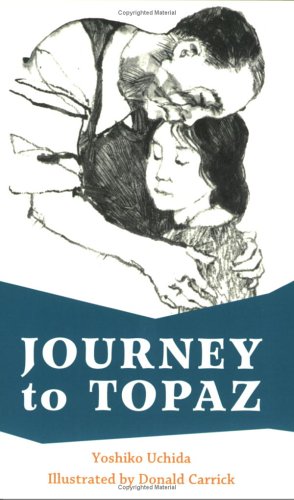
Uchida, Y. (1971). Journey to Topaz. Creative Arts Book Company: Berkeley.
Young Japanese girl
Goes to an internment camp
In Topaz, Utah
Delicate yet stark
Record of atrocity
Wreaked on innocents.
A cup of hot tea
And a handful of peanuts
Treasures between friends
Powerless and weak,
The maligned patriots wait
For a better time.
Tuberculosis
Strikes the young without warning
Falling in the dust.
A small trilobite
And a shard of arrowhead
Are they worth a life?
So many bright stars
Shine in the dark desert night
There is beauty here.
Freedom, freedom, free!
The air is somehow sweeter
Outside the barbed wire.
"As with many other picture books about war, The Journey is not for the very young. A sense of history and social justice is required to understand the events depicted. Children in grades 5 and up will see why Japanese Americans were among the first to speak up for Arab Americans during the current conflict. They'll also see how easily justice and compassion become casualties of war."
Polese, C. (1991). Journey to Topaz. School Library Journal 37(4), 43.
So many uses in the library! This would be excellent coupled with The Devil’s Arithmetic to discuss what similar things were happening in Europe. Or how about as part of a larger discussion about the American Immigrant Experience? There are many possibilities for expansion and exploration.
Subscribe to:
Posts (Atom)