Module 7
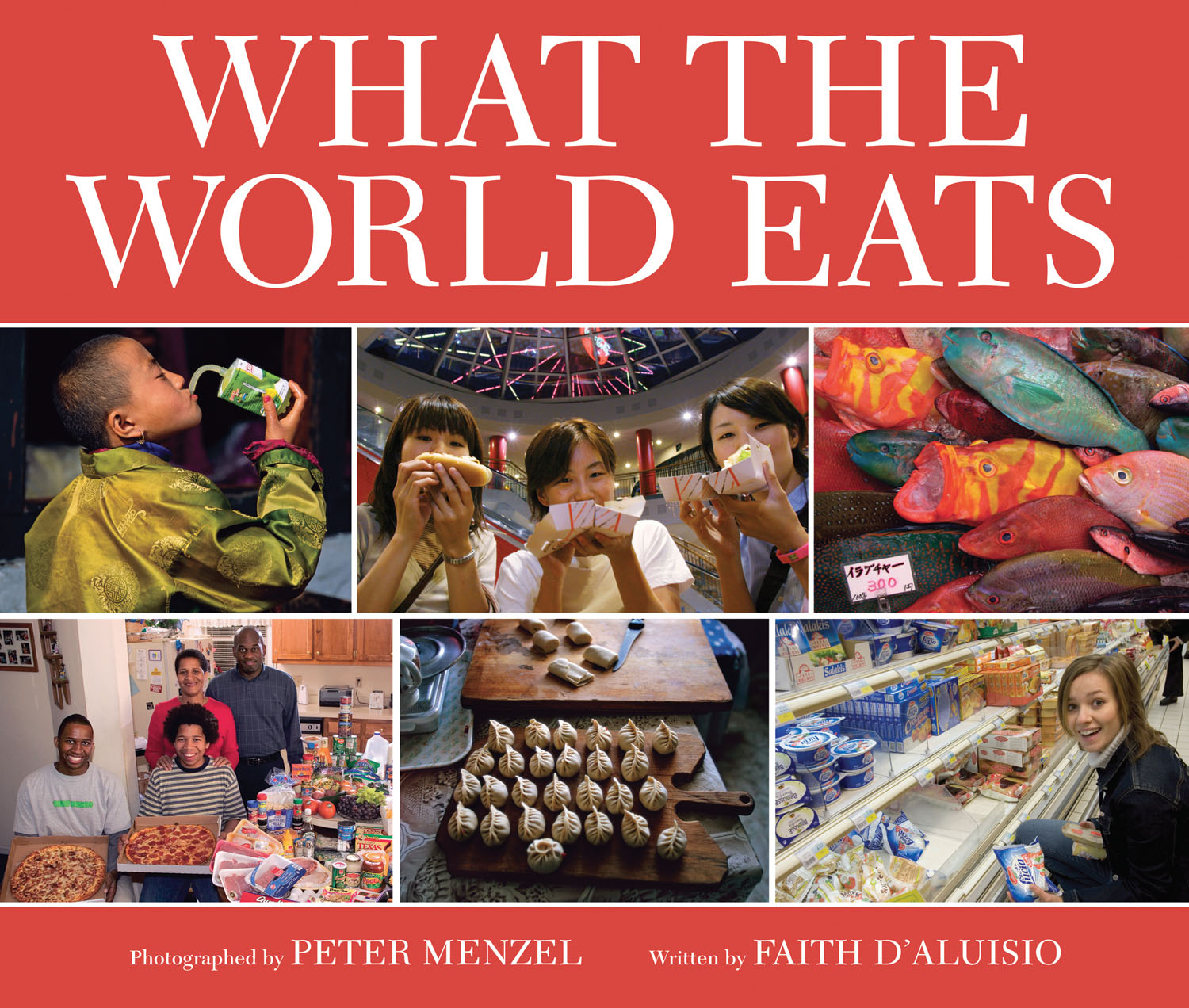
D’Alusio, F. (2008). What the World Eats. Berkley, California: Tricycle Books.
Faith D’Alusio and her life companion Peter Menzel visited countries all over the world and photographed 25 families in those countries surrounded by the food that each family would typically eat in one week. The text gives a little glimpse of the life of each family. Interspersed are charts and facts and figures having to do with eating habits and caloric intake and other aspects of food throughout the world.
My View:
This was one of my favorite books this semester. Maybe it’s my social consciousness streak taking over, but I found much to love here. The 25 families represented in the book’s pages seemed so fresh and approachable and willing to be known. I loved the smiles of pure kindness that shone out of what could be, by our standards, situations of utter misery. It reminds me of the Nepali faces I love so well. Innocence, or at least openness doesn’t have to disappear when there is little to go around. In fact, it seems that when there is less, there is even more determination to share. Another thing I liked was the abundance of fresh food in some of the poorest areas and the stark example of processed food in the areas where the economic condition allows the people access to more variety. For me, I want to live more simply and on less. Of course I would rather this be voluntary than enforced by economic stricture, but these wonderful families show it can be done, and done cheerfully. Now to help the boys get on board as well . . .
“Adapted from last year's Hungry Planet, this brilliantly executed work visits 25 families in 21 countries around the world. . . . Engrossing and certain to stimulate.”
— (2008). Children’s Books. Publishers Weekly 255(35), 55.
Ideas for the library: One of the suggestions for this year’s Summer Reading Program was that the kids choose one day and read every single label on the stuff they eat. In my family we don’t eat much that comes out of boxes and cans, but I know even so we have a whole pile of recycling every week. I’ll clip labels from those boxes and cans and ask my staff save labels from their food as well. I could paste them on a poster and have a whole display about our eating habits and ingredients—and the trends of our society. We have copies of Hungry Planet as well, and wouldn’t it be fascinating to have people think seriously about what they take into their bodies. I think I’ll add a few copies of Material World, Fast Food Nation, and Supersize Me as well. Interesting commentary and stimulus for discussion, eh? I hope it’s not TOO political.
10 August 2010
My Dutch Uncle
Module 6
Borden, L. (2004). The Greatest Skating Race: A WWII story from the Netherlands. New York: Margaret K. McElderry Books.
The Elfstedentocht, or Eleven Cities Race, can’t be held every year in the Netherlands because the canals don’t always freeze. But Pim Mulier, who was Piet’s hero, raced in record time. Then Piet, whose young Jewish neighbors must flee from the German soldiers. They need Piet to skate with them on a very long, cold winter afternoon across the border and to their aunt’s house and safety. Piet must call on his reserves of strength and courage as he takes his little neighbors out from under the watchful eyes of the soldiers. He carries the story of Pim Mulier in his heart, as well as a little red book that reminds him of the Elfstedentocht.
My View:
When I was in the middle of my student teaching and realized that the responsibilities I had would necessarily expand to fill all my available time, I decided to take a community education class so that there would be a little chunk of my life that was not governed by lesson plans of my own making, and the first growing pains of discipline issues. The class I wanted to take was Beginning Dutch. Uncle Darrel had lived in Holland for two years sometime after the war, and he was interested in taking the course with me. I had never spent much time with my uncle, but this class brought us together. He, with his bushy salt-and-pepper hair and his eagerness, and I with my German pronunciation and careful studying must have been an unlikely team. But we had a wonderful time and formed a bond with each other. He died not long afterward, and I get a little teary thinking of the sweet days we spent practicing our Dutch together. I had only an inkling then of what I know with deep certainty now, that language and communication are just vehicles for connection. Words are important to me, and it is through words that bonds are formed, even between an old Dutch uncle and his naive niece, and even between two little Jewish children and their brave but young neighbor. Connection matters.
“An exciting historical tale, fraught with suspense and illustrated with evocative watercolors.”
— (2005). School Library Journal 51(Supplement), 26.
Ideas for the library: Every year, Marcia teaches the storytime children to ice skate on paper plates. Wouldn’t it be fun to read this story aloud to the elementary aged Book Magic group and then let them skate a course through the library! I just love those windmill gingerbread cookies, and I think they sometimes appear at Costco. Here is the plan, we’ll read the story, then don our paper skates and maneuver through a course. We can do figure eights around the Children’s Fiction, weave in and out of the paperback racks, and cross the finish line by the Marshall Public Library rock. Then, heading back to the warmth and safety of the Kids’ Corner, we will eat hot cocoa and those delicious cookies. What fun!
Borden, L. (2004). The Greatest Skating Race: A WWII story from the Netherlands. New York: Margaret K. McElderry Books.
The Elfstedentocht, or Eleven Cities Race, can’t be held every year in the Netherlands because the canals don’t always freeze. But Pim Mulier, who was Piet’s hero, raced in record time. Then Piet, whose young Jewish neighbors must flee from the German soldiers. They need Piet to skate with them on a very long, cold winter afternoon across the border and to their aunt’s house and safety. Piet must call on his reserves of strength and courage as he takes his little neighbors out from under the watchful eyes of the soldiers. He carries the story of Pim Mulier in his heart, as well as a little red book that reminds him of the Elfstedentocht.
My View:
When I was in the middle of my student teaching and realized that the responsibilities I had would necessarily expand to fill all my available time, I decided to take a community education class so that there would be a little chunk of my life that was not governed by lesson plans of my own making, and the first growing pains of discipline issues. The class I wanted to take was Beginning Dutch. Uncle Darrel had lived in Holland for two years sometime after the war, and he was interested in taking the course with me. I had never spent much time with my uncle, but this class brought us together. He, with his bushy salt-and-pepper hair and his eagerness, and I with my German pronunciation and careful studying must have been an unlikely team. But we had a wonderful time and formed a bond with each other. He died not long afterward, and I get a little teary thinking of the sweet days we spent practicing our Dutch together. I had only an inkling then of what I know with deep certainty now, that language and communication are just vehicles for connection. Words are important to me, and it is through words that bonds are formed, even between an old Dutch uncle and his naive niece, and even between two little Jewish children and their brave but young neighbor. Connection matters.
“An exciting historical tale, fraught with suspense and illustrated with evocative watercolors.”
— (2005). School Library Journal 51(Supplement), 26.
Ideas for the library: Every year, Marcia teaches the storytime children to ice skate on paper plates. Wouldn’t it be fun to read this story aloud to the elementary aged Book Magic group and then let them skate a course through the library! I just love those windmill gingerbread cookies, and I think they sometimes appear at Costco. Here is the plan, we’ll read the story, then don our paper skates and maneuver through a course. We can do figure eights around the Children’s Fiction, weave in and out of the paperback racks, and cross the finish line by the Marshall Public Library rock. Then, heading back to the warmth and safety of the Kids’ Corner, we will eat hot cocoa and those delicious cookies. What fun!
An Angel in Hell
Module 6
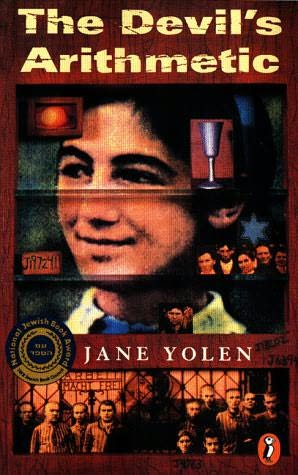
Yolen, J. (1988). The Devil’s Arithmetic. New York: Viking Kestrel.
Hannah, who is a little tired of her grandfather’s tirades about the Holocaust, opens the door to bid Elijah the prophet welcome to the family’s seder meal. When she opens the apartment door she is immediately swept into the Polish countryside and is caught up in the events of World War II. Hannah finds herself as part of a family, and is called Chaya by everyone. She is torn between her memories of home and her awareness of what may come. The whole village is rounded up and taken to a concentration camp where Chaya has the opportunity to save the lives of the people who will become Hannah’s family.
My View:
There are times when it seems as if one is plopped down in the middle of an uncomfortable situation, or at least an unfamiliar one. Every beginning of a semester, for example, brings the need to become familiar with a new set of rules, a new gathering of people, a new formula for learning. Similarly, when I moved from Ogden to Pocatello twelve years ago I found myself completely removed from friends and family and thrust into a new neighborhood with different terrain and unfamiliar people. Somehow, time makes things more congenial. For Chaya, or Hannah, there was the added dimension of some foreknowledge of the utter misery of the situation she saw unfolding all around her. Yet, despite the unfathomable horror of the events surrounding the Holocaust, she was able to think clearly and act in love and give others a chance for life. In my much easier life, I hope I can reach out and make some slight difference on the side of good in the lives of those around me. I may never be in a situation like Chaya’s. Oh, I hope not! But even so, I would rather practice small ways of improving life than leaving that to some indeterminate future that I hope will never arrive.
“Through Hannah, with her memories of the present and the past, Yolen does a fine job of illustrating the importance of remembering. She adds much to children’s understanding of the effects of the Holocaust, which will reverberate throughout history, today and tomorrow.”
Harding, S. M. (1988). The Devil’s Arithmetic (book). School Library Journal 35(3), 114.
Ideas for the library: I have multiple copies of this book, and students will have access in their school libraries as well. After our wonderful discussion at the coffee shop with the ecumenical forum, I’m sure I could ask Rabbi Levinson to come to the library and join a book group discussion about the Holocaust. In fact, this would be an opportunity for many more people than children. What if we had a Holocaust Memorial Day event. In 2011, Yom Hashoah (Holocaust Memorial Day) falls on May 1, which is a Sunday. If we had an event at the library, a lecture or discussion or even a display, although I lean toward a combination of these ideas, it would be good to have in the week preceding the actual memorial day. Well, I’ll talk with Rabbi Levinson. If we start thinking about it now, we can do something significant when the time draws near.
Yolen, J. (1988). The Devil’s Arithmetic. New York: Viking Kestrel.
Hannah, who is a little tired of her grandfather’s tirades about the Holocaust, opens the door to bid Elijah the prophet welcome to the family’s seder meal. When she opens the apartment door she is immediately swept into the Polish countryside and is caught up in the events of World War II. Hannah finds herself as part of a family, and is called Chaya by everyone. She is torn between her memories of home and her awareness of what may come. The whole village is rounded up and taken to a concentration camp where Chaya has the opportunity to save the lives of the people who will become Hannah’s family.
My View:
There are times when it seems as if one is plopped down in the middle of an uncomfortable situation, or at least an unfamiliar one. Every beginning of a semester, for example, brings the need to become familiar with a new set of rules, a new gathering of people, a new formula for learning. Similarly, when I moved from Ogden to Pocatello twelve years ago I found myself completely removed from friends and family and thrust into a new neighborhood with different terrain and unfamiliar people. Somehow, time makes things more congenial. For Chaya, or Hannah, there was the added dimension of some foreknowledge of the utter misery of the situation she saw unfolding all around her. Yet, despite the unfathomable horror of the events surrounding the Holocaust, she was able to think clearly and act in love and give others a chance for life. In my much easier life, I hope I can reach out and make some slight difference on the side of good in the lives of those around me. I may never be in a situation like Chaya’s. Oh, I hope not! But even so, I would rather practice small ways of improving life than leaving that to some indeterminate future that I hope will never arrive.
“Through Hannah, with her memories of the present and the past, Yolen does a fine job of illustrating the importance of remembering. She adds much to children’s understanding of the effects of the Holocaust, which will reverberate throughout history, today and tomorrow.”
Harding, S. M. (1988). The Devil’s Arithmetic (book). School Library Journal 35(3), 114.
Ideas for the library: I have multiple copies of this book, and students will have access in their school libraries as well. After our wonderful discussion at the coffee shop with the ecumenical forum, I’m sure I could ask Rabbi Levinson to come to the library and join a book group discussion about the Holocaust. In fact, this would be an opportunity for many more people than children. What if we had a Holocaust Memorial Day event. In 2011, Yom Hashoah (Holocaust Memorial Day) falls on May 1, which is a Sunday. If we had an event at the library, a lecture or discussion or even a display, although I lean toward a combination of these ideas, it would be good to have in the week preceding the actual memorial day. Well, I’ll talk with Rabbi Levinson. If we start thinking about it now, we can do something significant when the time draws near.
The Power of Esperanza
Module 5
Farmer, N. (2002). The House of the Scorpion. New York: Atheneum Books for Young Readers.
Matt has always lived on the Farm with Celia, who loves him. But when El Patron calls, everyone jumps, including Celia and Tam Lin, who is El Patron’s henchman. Young Matt doesn’t know where he fits into the whole system. Is he a favored son? It doesn’t seem like it. Is he a peon? Then why has El Patron taken such a fancy to him? Matt slowly comes to the realization that he is a clone of El Patron—built to be spare parts for the ancient man! After a very close call, Matt escapes and finds himself in one horrific situation after another. Is there nowhere in this Dystopia that he can be free? His only hope is to reach Esperanza.
My View:
Matt is certainly his own person. He has thoughts and feelings and dreams for himself. He wants to find Maria, for one thing. That is a huge motivator, as is the fact that El Patron has just tried to annihilate him. Survival is a very big motivator as well. He also hopes to reach Esperanza, which means Hope. Something about the very significant word and meaning makes me think of a poem by Rumi. It has a line that says, “When you ask the question, the answer will come.” Matt asked certain questions, and he thought about things hard enough that when the answers did come, he recognized them: for example, his organizing the orphan boys. They were without hope, he gave them Esperanza. Now, inevitably, the question comes around to the personal. What do I hope for? What is my life all about? Just as I can’t believe a clone’s life doesn’t have value, I believe my own also has value. Of course I’m not writing in any sort of despair or melancholy—I’m just stating that I recognize that everyone, clone or regular human, librarian or mom or both, each has value. As Roger said, questions trump answers. I think the hardest part is finding the correct words or images or thoughts or feelings or whatever it is, to mix together to formulate an effective question. And like the I Ching, an answer is something that can take a multiplicity of forms. Learn to ask, then to listen, then to act.
“The House of the Scorpion is a many layered, complicated novel about a clone becoming a man. Despite the science fiction aura of the tale, it is a coming-of-age story about a boy striving to find out who he is. Is he nothing more than a beast, a photograph of another human being, a repository of spare parts?”
Schneider, D. (2005). A clone becomes a man. Book Links 15(2), p23-26.
Ideas for the library: So often, when I recommend a book, I imagine the child or teenager embarking on a journey into another land. Because I have already taken that particular trip, I really want to know what they thought of it. Did they meet the same people, did they have similar impressions of the landscape and the activities? How were they affected by some situation or other? I often ask kids to tell me what they thought of a book I’ve recommended. In a way, those conversations become, as it were, an impromptu book group or community of the mind. This book is one that I especially wonder about. It would be a good book group selection—for a REAL book group, not just my little impromptu one-on-one ones. So, I’ll put this on the list as a potential candidate.
Farmer, N. (2002). The House of the Scorpion. New York: Atheneum Books for Young Readers.
Matt has always lived on the Farm with Celia, who loves him. But when El Patron calls, everyone jumps, including Celia and Tam Lin, who is El Patron’s henchman. Young Matt doesn’t know where he fits into the whole system. Is he a favored son? It doesn’t seem like it. Is he a peon? Then why has El Patron taken such a fancy to him? Matt slowly comes to the realization that he is a clone of El Patron—built to be spare parts for the ancient man! After a very close call, Matt escapes and finds himself in one horrific situation after another. Is there nowhere in this Dystopia that he can be free? His only hope is to reach Esperanza.
My View:
Matt is certainly his own person. He has thoughts and feelings and dreams for himself. He wants to find Maria, for one thing. That is a huge motivator, as is the fact that El Patron has just tried to annihilate him. Survival is a very big motivator as well. He also hopes to reach Esperanza, which means Hope. Something about the very significant word and meaning makes me think of a poem by Rumi. It has a line that says, “When you ask the question, the answer will come.” Matt asked certain questions, and he thought about things hard enough that when the answers did come, he recognized them: for example, his organizing the orphan boys. They were without hope, he gave them Esperanza. Now, inevitably, the question comes around to the personal. What do I hope for? What is my life all about? Just as I can’t believe a clone’s life doesn’t have value, I believe my own also has value. Of course I’m not writing in any sort of despair or melancholy—I’m just stating that I recognize that everyone, clone or regular human, librarian or mom or both, each has value. As Roger said, questions trump answers. I think the hardest part is finding the correct words or images or thoughts or feelings or whatever it is, to mix together to formulate an effective question. And like the I Ching, an answer is something that can take a multiplicity of forms. Learn to ask, then to listen, then to act.
“The House of the Scorpion is a many layered, complicated novel about a clone becoming a man. Despite the science fiction aura of the tale, it is a coming-of-age story about a boy striving to find out who he is. Is he nothing more than a beast, a photograph of another human being, a repository of spare parts?”
Schneider, D. (2005). A clone becomes a man. Book Links 15(2), p23-26.
Ideas for the library: So often, when I recommend a book, I imagine the child or teenager embarking on a journey into another land. Because I have already taken that particular trip, I really want to know what they thought of it. Did they meet the same people, did they have similar impressions of the landscape and the activities? How were they affected by some situation or other? I often ask kids to tell me what they thought of a book I’ve recommended. In a way, those conversations become, as it were, an impromptu book group or community of the mind. This book is one that I especially wonder about. It would be a good book group selection—for a REAL book group, not just my little impromptu one-on-one ones. So, I’ll put this on the list as a potential candidate.
The Surest Way to Travel Back in Time
Module 5
Juster, N. (1961). The Phantom Tollbooth. New York: Epstein & Carroll.
Milo, who is never very happy to be where he is, but when he goes somewhere else is not happy to be there either, finds a mysterious package in his bedroom. It is a tollbooth that takes him to the Lands Beyond. Oh my! He travels through the Doldrums, Dictionopolis, Digitopolis and other places with his faithful Watchdog looking for Rhyme and Reason to put the messed up kingdoms straight. A book of many levels.
My View:
When I picked up this book and began to read it one afternoon at the farmers’ market, I was amazed to find myself transported back to my fifth grade classroom at Emerson School. I could recall my seat, the long waterfall of Kristine Nordstrom’s hair in front of me, and even the quality of light coming through the west windows of the class. Now all those things are gone. The school has been replaced these thirty years now with a brick and glass structure on the old field. I haven’t seen or thought about Kristine for years, and I’m pretty sure that my old teacher is no longer among the living. But somehow reading those words I read so many years ago brought back the experience as if I had been eating a madeleine. For me, words do evoke more than just images. They are a sort of memory bank that records more than just the plot but also all my surroundings at the time I read it. I turned back into a fifth grader as I mined numbers and threw away jewels in Digitopolis. Similarly, I can go back to the feeling I had of new love whenever I read A Ring of Endless Light—recalling my first and last lovely days with Jeff so many years ago. And I’m sure that when I revisit The Book of Ebenezer LePage in years to come, I will again be back in those lovely final days before my life changed so drastically and Rhyme and Reason fled. Like Milo, I still seek them. Maybe they will reappear in time.
“Since its publication, the book has delighted young and old with Juster's humorous writing style and his wonderful play on words. It's time for this book to be re-introduced to a new audience. Students and teachers alike will find wonderful sentences for motivational quotations.”
Burdbridge, C. A. (1996). The Phantom Tollbooth, Book Report 15(2), 39.
Ideas for the library: Oh, this book has such potential! I can imagine an entire Phantom Tollbooth Party with different stations marked with the names of places Milo visited. In the Doldrums, kids would have to follow a maze or labyrinth, in the city of Dictionopolis, they could fill in a mad lib. Digitopolis could be a station where the kids could hunt for treasures (mine numbers) in a little wading pool filled with shredded paper. Oh, the ideas are limitless. I was thinking it would have to be done for a group of kids very familiar with the book, but now I’m not so sure. Plenty of newcomers came to the Narnia party and the Lemony Snicket day who just showed up for the fun. Those who know the story will get more out of it, but even those who just want something to do on a Saturday morning would have fun. Hmmm. I’ll see what the staff thinks.
Juster, N. (1961). The Phantom Tollbooth. New York: Epstein & Carroll.
Milo, who is never very happy to be where he is, but when he goes somewhere else is not happy to be there either, finds a mysterious package in his bedroom. It is a tollbooth that takes him to the Lands Beyond. Oh my! He travels through the Doldrums, Dictionopolis, Digitopolis and other places with his faithful Watchdog looking for Rhyme and Reason to put the messed up kingdoms straight. A book of many levels.
My View:
When I picked up this book and began to read it one afternoon at the farmers’ market, I was amazed to find myself transported back to my fifth grade classroom at Emerson School. I could recall my seat, the long waterfall of Kristine Nordstrom’s hair in front of me, and even the quality of light coming through the west windows of the class. Now all those things are gone. The school has been replaced these thirty years now with a brick and glass structure on the old field. I haven’t seen or thought about Kristine for years, and I’m pretty sure that my old teacher is no longer among the living. But somehow reading those words I read so many years ago brought back the experience as if I had been eating a madeleine. For me, words do evoke more than just images. They are a sort of memory bank that records more than just the plot but also all my surroundings at the time I read it. I turned back into a fifth grader as I mined numbers and threw away jewels in Digitopolis. Similarly, I can go back to the feeling I had of new love whenever I read A Ring of Endless Light—recalling my first and last lovely days with Jeff so many years ago. And I’m sure that when I revisit The Book of Ebenezer LePage in years to come, I will again be back in those lovely final days before my life changed so drastically and Rhyme and Reason fled. Like Milo, I still seek them. Maybe they will reappear in time.
“Since its publication, the book has delighted young and old with Juster's humorous writing style and his wonderful play on words. It's time for this book to be re-introduced to a new audience. Students and teachers alike will find wonderful sentences for motivational quotations.”
Burdbridge, C. A. (1996). The Phantom Tollbooth, Book Report 15(2), 39.
Ideas for the library: Oh, this book has such potential! I can imagine an entire Phantom Tollbooth Party with different stations marked with the names of places Milo visited. In the Doldrums, kids would have to follow a maze or labyrinth, in the city of Dictionopolis, they could fill in a mad lib. Digitopolis could be a station where the kids could hunt for treasures (mine numbers) in a little wading pool filled with shredded paper. Oh, the ideas are limitless. I was thinking it would have to be done for a group of kids very familiar with the book, but now I’m not so sure. Plenty of newcomers came to the Narnia party and the Lemony Snicket day who just showed up for the fun. Those who know the story will get more out of it, but even those who just want something to do on a Saturday morning would have fun. Hmmm. I’ll see what the staff thinks.
Each One Different, Each One the Same
Module 4
Birdsall, J. (2008). The Penderwicks on Gardam Street. New York: Alfred A. Knopf.
The Penderwick sisters are back. This time, they have to work together to thwart their father’s half-hearted attempts to date again. (I completely understand his reticence). But this book is more than just scheming. It is sisterly love and support and the odd sisterly violence as well. It also has an extremely satisfying end.
My View:
I don’t remember having this much fun as one of the three Luker sisters. Oh, we all had our areas of expertise: I was the writer, Mara the musician, and Willow was the artist. In a way we all developed in each other’s areas as well, but with less whole-heartedness. The Penderwick sisters are also brilliant individuals, but with enough heart and caring for one another to make them human. Mr. Penderwick is one of my favorite characters. He is smart, funny, and broken hearted. I loved how the girls grew so quietly accustomed to their next door neighbor.
“ Jeanne Birdsall's second book about the Penderwick family is even better than her first. . . . Birdsall plans at least three more installments to this series.” Steele, L. (2008) The Penderwicks on Gardam Street (Review). School Library Journal, 54(9), p75-76.
Ideas for the library: In German, Hilary McKay’s Exiles book is titled Vier Verrückte Schwestern, or Four Crazy Sisters. Well, the Penderwicks are the closest characters I have found to an American approximation of McKay’s wonderful people. Over the years I have introduced many to McKay’s works, and now she has quite a following in Pocatello. The Penderwicks are just as enchanting and I will promote these books to the same folks.
Birdsall, J. (2008). The Penderwicks on Gardam Street. New York: Alfred A. Knopf.
The Penderwick sisters are back. This time, they have to work together to thwart their father’s half-hearted attempts to date again. (I completely understand his reticence). But this book is more than just scheming. It is sisterly love and support and the odd sisterly violence as well. It also has an extremely satisfying end.
My View:
I don’t remember having this much fun as one of the three Luker sisters. Oh, we all had our areas of expertise: I was the writer, Mara the musician, and Willow was the artist. In a way we all developed in each other’s areas as well, but with less whole-heartedness. The Penderwick sisters are also brilliant individuals, but with enough heart and caring for one another to make them human. Mr. Penderwick is one of my favorite characters. He is smart, funny, and broken hearted. I loved how the girls grew so quietly accustomed to their next door neighbor.
“ Jeanne Birdsall's second book about the Penderwick family is even better than her first. . . . Birdsall plans at least three more installments to this series.” Steele, L. (2008) The Penderwicks on Gardam Street (Review). School Library Journal, 54(9), p75-76.
Ideas for the library: In German, Hilary McKay’s Exiles book is titled Vier Verrückte Schwestern, or Four Crazy Sisters. Well, the Penderwicks are the closest characters I have found to an American approximation of McKay’s wonderful people. Over the years I have introduced many to McKay’s works, and now she has quite a following in Pocatello. The Penderwicks are just as enchanting and I will promote these books to the same folks.
The Greatest Treasure of All
Barrows, A. (2006). Ivy + Bean. San Francisco, California: Chronicle Books.
Looking out from their own yards, neither Ivy nor Bean wants to get to know the other. But when circumstances bring them together, they immediately become best of friends. Neighborhood, look out!
My View:
It was my second day in Michigan and I was still reeling from the huge changes in my life. I had arrived home from a wonderful and life-enriching study abroad in England, then left to live in Michigan almost before the jet lag had worn off. I was still missing my friends in that green and pleasant land, and not quite ready to make new ones in a new, humid, rapid-paced place. But my roommate persuaded me to go to Ann Arbor to a meeting, and afterwards, a middle aged woman and her husband came up to us and asked us to join them for dinner. My roommate was pleased, I was quiet, and off we went. I don’t remember much about the dinner, just an impression of friendly country folk and a sense of welcome amid the strangeness of everything. Then we drove home to Howell and I went to sleep, still a bit askew in my directions and thoughts.
The next day we ran into the couple again, and as I was more awake and alert, we began to talk. Over the course of the next six months, my internal compass was completely realigned. I woke up to the realization that these fine folks were some of the best and most sincere friends I could ever have. I knew almost innately where their farm was, no matter where I moved throughout southeast Michigan. Even now I can point with precision to that center spot. Friendship is the greatest treasure of all.
“With echoes of Beverly Cleary's "Ramona" series, this easy chapter book will appeal to children who are graduating from beginning readers. The occasional black-and-white illustrations highlight the text and provide visual clues. The characters are appealing, the friendship is well portrayed, and the pranks and adventures are very much on grade level.”
Stone, E. O. (2006). Ivy and Bean (review). School Library Journal 52(7), 68.
Ideas for the library: Last year we made a Valentine’s Day display with the banner “Red any good books lately” hanging above it. This coming year, if I remember, I’d like to stock my children’s display shelf with books highlighting Great Literary Friendships: Anne and Diana; Ivy and Bean; Betsy and Tacey; Frances and Thelma; Henry and Mudge; Mr. Putter and Tabby; Nancy, George, and Bess; and of course, Arabel and Mortimer.
Subscribe to:
Posts (Atom)